Remarkable things happened in Gordon’s Bay this month.
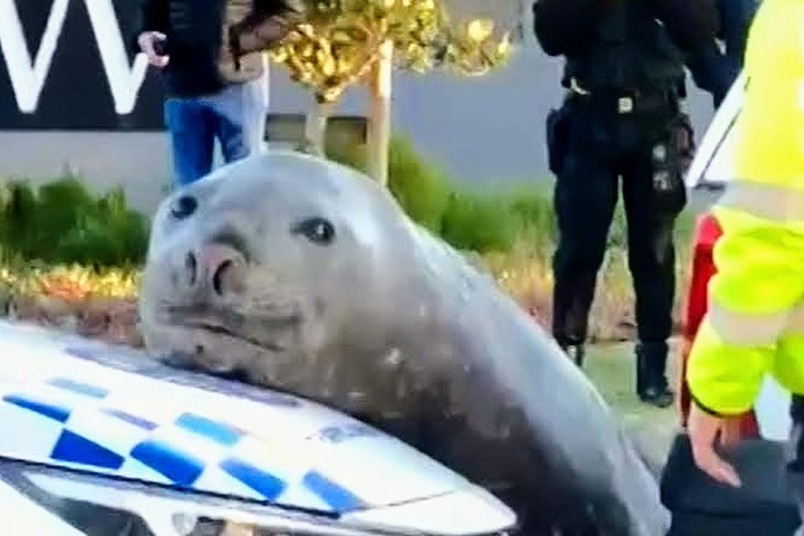
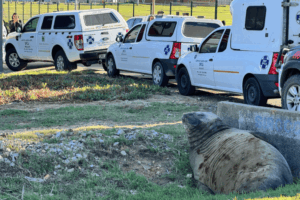
Firstly, a young, sub-adult, Southern elephant seal crawled out of the ocean and flip-flopped his way into a Gordon’s Bay suburb, seemingly oblivious of the cars and other human activity surrounding him. An incredulous crowd gathered, and someone videoed the young seal as he rested his head on a stationary car before flopping onto a pavement.
There are, sadly, many places in Africa where stones might have been hurled at the helpless creature by young boys, before men armed with knobkerries and knives would have arrived to cudgel the seal to death before hacking his body up for the pot. Elephant seals have a lot of blubber to keep themselves warm in the cold waters, which would be coveted by the villagers.
But not the residents of Gordon’s Bay. Rather than harming the seal, they named him Gordy and sprang into action, gathering the most comprehensive group of helpers imaginable to return the youngster back to the sea. The long list of people who dropped everything to assist included the police, the Good Hope SPCA, the City of Cape Town’s Marine Unit – who brought with them a large game capture trailer to transport the large animal (who in time will weigh around three and a half tonnes) – as well as representatives from SANParks, Two Oceans Aquarium and Shark Spotters (people who spend their days in the mountains that overlook False Bay, scouring the waters for sharks – particularly great whites – to warn bathers of pending danger). I know this because they once watched a great white circle a decidedly flimsy, unstable inflatable canoe that I was paddling in the Bay – but that is another story. Apart from these experts the traffic services, ambulance, and security services also arrived to lend their help. A wildlife veterinarian sedated the animal for safe transport back to the nearby sea. The operation went smoothly, as the videos of him quietly exiting the game capture trailer and finding familiar salty water showed. It was a remarkable team effort that restores some faith in a world that seems to have gone completely mad.
But what on earth was a large elephant seal doing wandering down a suburban road in broad daylight?
A friend of mine suggested that he was looking for a Mugg & Bean and a newspaper – which, I guess, is a possibility in some alternate universe. The truth is that elephant seals spend almost all their time out to sea, mostly in the icy waters of Antarctica. They generally come onto land twice in a year: once to breed from September to November, using remote islands as well as the beaches of Patagonia; and again to moult.
When they are out at sea, the waters are close to freezing, so they need to retain body warmth. This, these expert fishers do by building up blubber, which is a part of their armoury to allow them to dive to depths exceeding seven thousand feet. To attain this extraordinary depth, they have evolved an ability to store oxygen in their blood and muscles rather than their lungs. This allows them to stay under the surface for up to two hours – longer than any mammal other than the Cuvier’s beaked whale, which has had a dive recorded at over three and a half hours and which reaches depths of almost ten thousand feet. They achieve this by collapsing their lungs to avoid the various nitrogen absorption, such as decompression sickness (the bends) that can afflict scuba divers. Elephant seals share this lung-collapsing ability, enabling them to withstand the immense pressures at such depths.
This harsh lifestyle puts massive stress on their skin and fur, which needs to be in top condition. So, the other time that they come onto land is to completely replace both their skin and fur in what is termed a ‘catastrophic moult’. Over a period of around two weeks, they shed all their old skin while the new skin and fur grows under the old. During this time, they don’t enter the water or eat, relying on their blubber resources to sustain them. When they have finished this remarkable transformation, they are ready to re-enter the frigid ocean.
Males perform this moult in May and June, which probably explains what our friend, Gordy, was doing on land. He was likely to have been looking for a sheltered place to lay up for a while to replace his skin, in which case he might have been a bit bleak to find himself back at sea, but not nearly as bleak as he may have been if he had not chosen such a caring town to go for a stroll in.
As the ‘catastrophic moult’ is generally not a solitary event, it is also possible that he simply got disorientated and was surprised to find himself in suburbia. Whatever the reason, congratulations on a job well done are due to all those who returned the seal to the ocean. We all need more heart-warming stories like this.
Gordy, almost certainly experiencing a physiological imperative to shed his skin, has since swum west across the extensive False Bay and has popped out of the water in the Simon’s Town Naval Base, making himself comfortable amongst the sailors. This time, he has chosen a safer place to rest – without vehicle traffic – and the authorities have realised that he needs to be on land to moult in peace over the next couple of weeks.
He will become very patchy as his skin cracks and peels, and the old fur comes off in large sheets, leaving behind a fresh pinkish, silvery skin covered by new fur. well-meaning observers may mistake this appearance for illness or disease and intervene, but this extraordinary and almost unique adaptation is entirely normal. Soon, he will look healthy once more and dive back into the ocean sporting his new insulating coat.