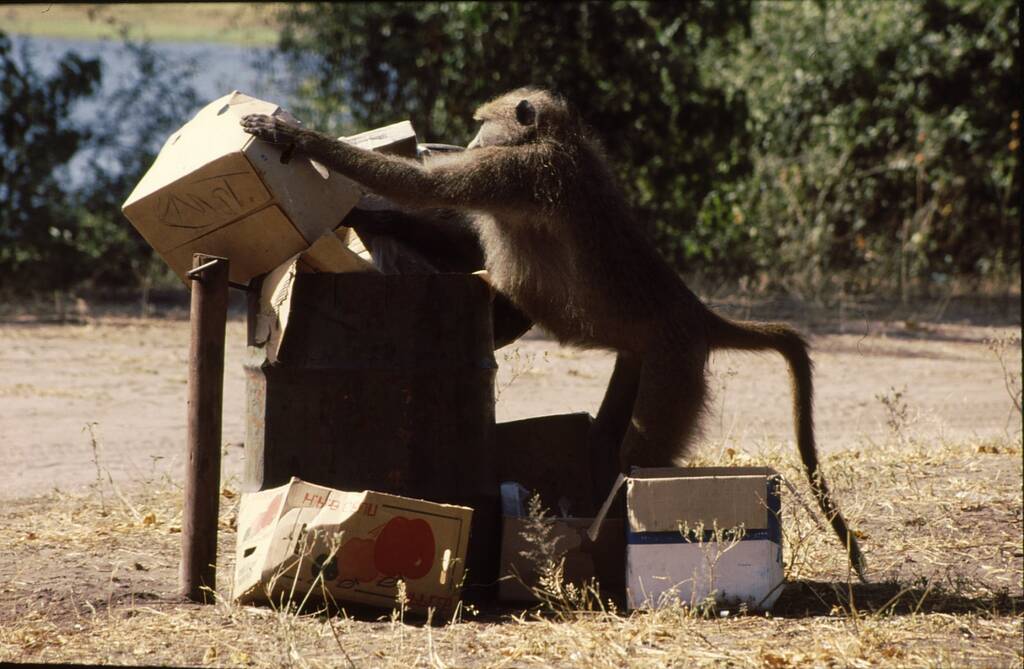
On a game drive in Moremi, I watched a troop of baboons mock charge a sleepy pride of lions. One male picked up a sturdy branch which he brandished grandiosely at the lions. The lions raised their heads and watched attentively but didn’t bother to even sit up. I, however, straightened in my chair. Was I watching an evolutionary adaptation where another group of primates was learning to use weapons against their enemies?
We universally believe that tool making is the main thing that differentiates humans from animals. While we can make sophisticated machines that fly, dive deep under water and send moving pictures to our living rooms, we are far from the only animals to use tools.
Pretty much every group of complex animals – mammals, birds, fish and even invertebrates – has some members that routinely use tools which are generally defined by our scientists as external objects used to achieve a specific goal, such as obtaining food, grooming, or protection.
Among the primates our closest cousins, chimpanzees, are famous for “fishing” for termites with twigs, using stones as hammers to crack nuts and sharpening sticks into “spears” for hunting small mammals. They also apply insects to wounds of family members to speed up the healing process. Orangutans cleverly use sticks to extract seeds from prickly fruits and have been observed using leaves to alter the pitch of their calls to sound larger to predators. I have been bowled over by a cavorting mountain gorilla in Rwanda that had been eating the leaves of an intoxicating plant and was essentially drunk and boisterous. They were having so much fun, but I was not allowed to try the leaves. While that may not strictly be considered tool use, gorillas do use sticks to test the depth of water before they cross. Aside from the great apes, the capuchin monkey is skilled at using heavy stones as hammers and flat rocks as anvils to crack open hard nuts. Domesticated animals have been taught to use tools. There are many such examples, which indicate that tool use is learned behaviour rather than instinctive in many cases. Near Cape Town was an endearing pig who uses a paintbrush to apply paint to canvas. The masterpieces are for sale and the funds are used to provide the artist and her friends with food, which might not be the precise definition of tool use that our scientists had in mind.
In the sea, bottlenose dolphins protect their snouts with sponges when foraging on the seabed while sea otters, in an incredible evolutionary adaptation, carry rocks in specialized skin pouches to use as hammers or anvils for smashing open shellfish while floating on their backs. Evolution over millennia developed pouches so that these critters could free up their paws for hunting and then delight in fresh seafood while doing the backstroke. The coconut octopus carries halved coconut shells over long distances to use as portable shelters. It took us years to come up with the caravan.
Even wasps and spiders have got into the tool making business. Digger wasps use small pebbles or stones as hammers. After laying eggs on a paralysed caterpillar in an underground burrow, the wasp fills the hole with loose soil. She then picks up a pebble in her mandibles and repeatedly pounds the ground to compact the dirt, making the nest entrance virtually invisible to predators. The almost biblical Stanwellia spider uses a stone to physically block its burrow entrance when being attacked by a predator.
But it is birds that fascinate me the most. New Caledonian crows manufacture specifically designed hooked twigs and serrated leaf strips to extract grubs from tree holes. That takes a level of intelligence not generally ascribed to creatures with bird brains. Egyptian vultures emulate primates by using stones to hammer and crack open large ostrich eggs and woodpecker finches use cactus spines or twigs to pry insects from tree bark, much like chimps do with termites.
It is the honeyguide that gets me though. This drab, small, honey-loving bird uses the most sophisticated tools of all – man. Although it also uses honey badgers, the animation when it spots a human is legendary. It chirps frantically and frenetically flies from branch to branch to attract attention. Once you get the message this bird will guide you to a beehive which it expects you to break open, take your share of honey but leave something for your guide. I have been the object of such an excited honeyguide and followed it to see where the hive was. I found myself clambering over fallen trunks, slopping through clinging mud and crawling through almost impenetrable bush. The frustrating bird changed direction innumerable times but never got to the point where it stopped and indicated a beehive. Finally, to the frenzied bird’s utter disgust, I gave up the chase. I was covered in scratches, sweat and mud and totally disorientated. I am not sure that our esteemed scientists would qualify this bird’s behaviour as tool use, but I, for one, felt like a tool.